Are you made of Rubber?

You need to be.

Especially if you’re operating on the edge, in a startup, paving a new path, or pushing to achieve your own goals.

There are no rules at the edge, you make them, and often there are many speed bumps or friction.

There are times when things go sour and it all falls apart, you’ve hit rock bottom.

No you haven’t.

This is just a part of the process of getting to where you need to go, you’re made of rubber, so you need to bounce back, harder, faster and higher than before.

Then keep at it.

December 10th, 2008

Job Description Marketing

Probably a couple of times a month I get a job description or two across my email, to forward to friends, field interest etc.

I always have a flick through and to be honest I don’t think they ever put enough effort into a job description.

A job description should communicate a story;

  • This is the story we want the employee to make happen in our organisation
  • The story as to why you should work for us
  • A story about the ideal candidate

Honestly if you have an uninspiring job description with mediocre (more often than not) copied/pasted descriptions your going to get average employees.

Few start ups have videos, showing the team, where you’d work, what you’re expected to do, sure I bet the results are lower but the quality would be much much higher.  That’s a story that will be perfect for one employee.

So if your looking to bring someone on board, remember its as much a marketing decision as a culture, strategy and organsiational one.

Have you ever been put off a job just by the description?

December 9th, 2008

Contexts

All communications are in a context.

The music I listen to in the cafe.

The no natural light supermarket

Whether i’m passively watching television or watching a movie.

It’s all within a context and that context influences your message.

The fact that this is delivered via my blog vs the local paper influences the content and the received message.

Now imagine your customer, where they will engage, what is the context, now build that into your message.

December 8th, 2008

Am I Smiling?

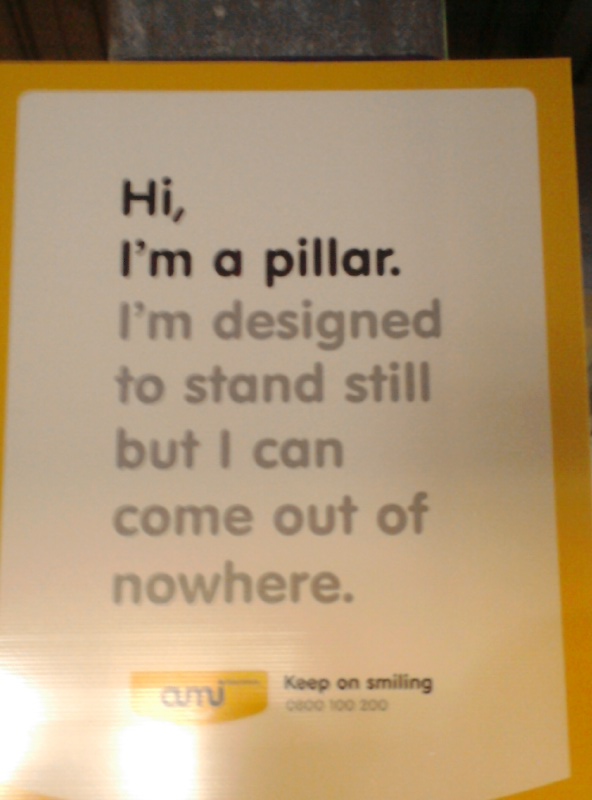
I was after parking on Sunday in the city.

Upon entry I was presented with:

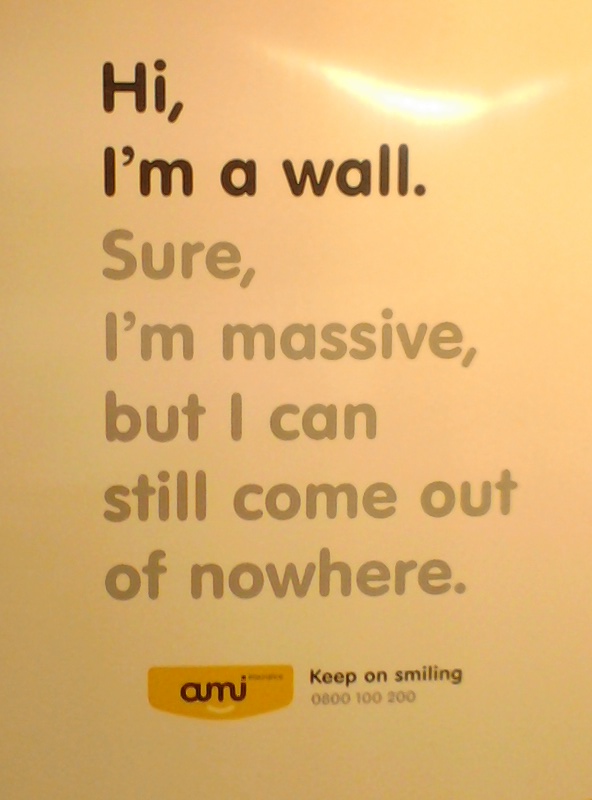
Then as we turned to go up a floor,

On the wall there was also:

And so then with a smile on my face, I went off on my business.

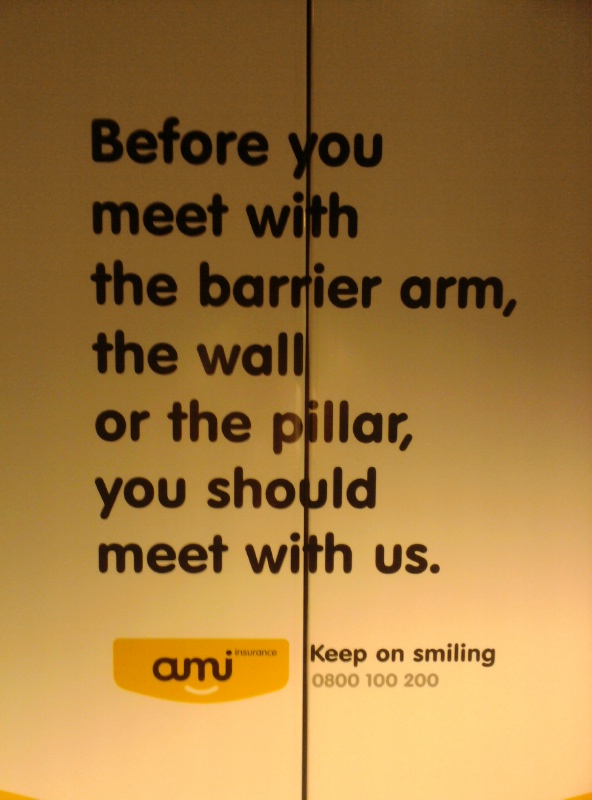
Returning an hour or so later, I noticed this on the lift doors:

This is so well executed, once one person in the car had seen it, everyone else checked out the next one.

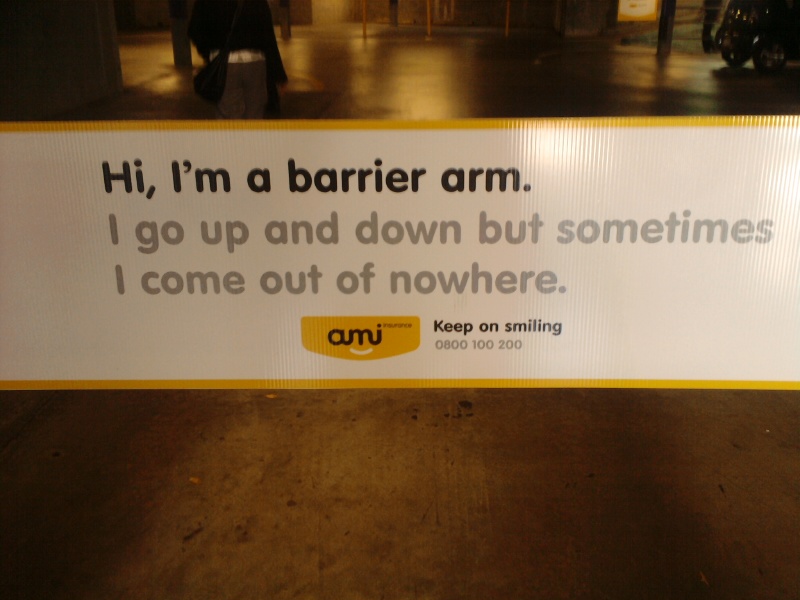
Finally upon exit there was another one on the barrier arm.

Great concept, it was interesting enough to make me smile and tell others.

Now that its been done once though, it’s become disposable…. 

(but still neat huh?)

How can you take what worked here for your own campaign? can you make that into a business? maybe.

What made this work?

  • Located in high traffic area
  • No dilution or prior ads in this space
  • Target market, everyone that sees it is in a car (which is insurable)
  • Stress situation, slight stress as you drive in a parking building to not hit anyone or anything
  • Reinforcement: at the lift, upon exit
  • Funny, interesting, remarkable, worth commenting about
Can you take these elements away and apply them to your own spreading of ideas? give it a shot, who knows where it may end up.
December 7th, 2008

Activate your passive users

First sit down and have a think.

What is a passive user to me?

and then

What is an active user?

Ok.

Now what does a passive user have to do (actions) to become an active user.

Now what barriers are there in that process? Remove all barriers. Make it easy.

Done.

Now, what action am i stimulating?

Make the engaged user emotive enough to begin the process.

December 4th, 2008

Communicating

Communicating is the best skill we have. The ability to spread a story via a delivery mechanism.

Visual or Audible.

Visual through body language, dress, colours, text.

Audible through speech, podcasts.

Question I get asked very often is, i want to approach x company/person to talk about x.

Quite often I backtrack and go.

What is the objective? what is the next part of the story, how should the story end?

Now what do i need to do to go down that path?

Then do it.

December 3rd, 2008

Design for the wrong audience

Having had some photos taken for upcoming projects, one of the ‘poses’ I had to do was face one direction, but look at the camera.

It’s like doing something but twisting it so its not quite natural.

It’s like a book for those who don’t read

Or an mp3 player for those who aren’t tech savvy

Or a internet radio station for those who don’t listen to the radio

What product can you take out of its normal context and realign it?

Chances are you can blow open that space and own it.

December 2nd, 2008

You wonder why Star Bucks is struggling?

Visit a Star Bucks in Auckland and you will get some insight.

And you get American Christmas Carols, a warm atmosphere and range of special christmas coffees.

It’s like you’ve stepped into a different world.

New Zealand isn’t the states, it’s not cold here, it’s coming into summer.

How about some local kiwi drinks? with a kiwi feel?

Star Bucks ignorance to adapt to the local market speaks loudly….

Even McDonalds has realised that Kiwi’s appreciate the effort. I suspect its the same in other countries, have you been to Star Bucks overseas, what did you think?

December 1st, 2008

You have the data now help them!

Toying around with MySpace earlier today with someone else I noticed a couple of things.

1) I instantly knew which sections of the webpage contained relevant information and focused on those areas.

2) My friend did not, they read all the text.

3) They were logged into MySpace and have been using it for a long time.

A few things ticked into place.

If you have a user, and you know how they behave on your site and you wish them to invest heavily in it, why not invest in them?

Monitor users use of the site, complete A/B testing and figure out what users ‘capabilities’ are.

Then give them a slightly different experience, experienced users get the full html view, inexperienced get the easy to use editor with instructions.

We now have the data to do this, on a huge scale, why aren’t we doing it?

So my idea is to provide this as a service, conduct usability studies, suggest segments and build around them.  Migrate users over time.

This way you can give me everyone a more personalised service.

We already do it for Marketing Campaigns (based on keywords) why not the user experience?
November 30th, 2008

No Strings Attached

I was reading this brilliant article on Yoshiro Nakamatsu, Japanese Inventor.

A modern day Nikola Tesla.

This paragraph struck out to me:

“The key to successful innovation, according to Nakamatsu, is “freedom of intelligence.” By this he means working with no strings attached. Nakamatsu says he has never sought funding from any person, company or government and prefers to develop and produce his own inventions. “If you ask or borrow money from other people, you cannot keep freedom of intelligence,” he says simply.”

This freedom, opens up the potential to anything you can dream of.

Seth Godin says the same on his blog, he doesn’t work for anyone, or allow comments as that may impair him.

Really he wants to unleash the possibilities.

It was on this point I wanted to say this blog has no strings attached.

This isn’t here to push products out there.

It’s to provide an outlet to get ideas out there.

Like Seth I had no comments, but opened it up, to let you guys talk.

As honestly (if you know me well) I do what I want anyway. No strings attached.

November 27th, 2008

The Magic Button

Just need to find it and press it.

Bam! A Puff of Smoke.  Instant success.

Except its not really like that.

Want to know the real truth? Here it is for free.

The answers are already there, you just have to look for them

AND

Put in the hard work.

So stop wasting thousands of dollars on buying the magic answer and put the work in.

November 26th, 2008

Polarise People

Recently in a podcast I listened to from Tim Ferris,

His key idea for a successful blog was to do three things:

  1. Challenge peoples beliefs
  2. Challenge their existing behaviour
  3. Challenge their belongings (ownerships to)

All of these polarise people.

By polarising you draw out emotions and passions.

It’s true, we like to talk about things that are remarkable, neat, different.

So want to get people to talk? polarise them.

November 25th, 2008

Spread a smile

Aristotle said the goal of all human activity should be happiness (including business).

Smile at someone and they smile back.

Same with yawning.

You spread the word, fast, easy and simple.

This is like joy, bring your customers joy, happiness, excitement.

The best forms of word of mouth.

If you bring someone happiness they will spread it and/or others will notice.

iPods are sold on enjoyment, videos go viral because they make you laugh or cry, business referrals come from those that are happy with your service.

Does your product genuinely make your customers happy?

If not, it should. Spread a smile 🙂

(you know you want to)

November 24th, 2008

The problem of legitimising

With a start up how do you legitimise?

What makes this concept real? how can we communicate that? how do we convince people that in all likelihood we will never meet but conduct business with?

Quotes, press releases, buzz, real physical address, photos via flickr, blogging, techcrunch mention..

All different routes.

How about a standard, a brand, voted for by the industry, like the Intel Inside brand.

A brand that reinforces legitimacy and rewards action.

Certain actions provide points, and start ups are only admitted once they have met criteria set by the community.

A brand that says we are a real business and are here for the long haul.

Now I’ll be the first to say, this isn’t for everyone, and if you are facing legimacy problems maybe there’s something bigger wrong.

However there is a real market need.

I don’t think this is quite the answer, but it’s less wrong than no answer…..

November 23rd, 2008

Condensing

As I discussed in a prior post about the 80 / 20 Rule roughly speaking 20% of causes create 80% of consequences.

It was upon this (and other trends) the 12 Hour Startup idea came into fruition, the idea that in a condensed time frame you can stimulate these causes that in the long run will drive big consequences.

We all know the stories, those that stayed up all night to complete that essay that go them an A, doing a proposal last minute, no matter what happens we seem to always slide it in.

My thought is to encourage this more often, we are going to build this product by next week, I am going to finish that job by Monday as it’s been sitting around too long.

You should try it, put some pressure on yourself to complete more of the things that are important in condensed time frames.

You’ll be surprised at how often you nail it.

This is exactly how this blog came about, I spent April this year doing a road trip around the South Island of New Zealand writing blog posts, and i gave myself a 24 hour deadline to get the blog up and running with my first post.  Wham, Bam, Done. 

So what do you have in motion that you can condense and get it done?

(and then you can move onto the next mountain)

November 20th, 2008

What are you doing all the way down here? You could:
- View my about page
- Or for first timers the New Here? page
- Or maybe email this to a friend
- Or subscribe to get blog updates