It's the little things that people notice
The silver fern pattern on the top of your espresso, the smile of the attendant at the petrol station, the thank you note included with your proposal. People notice. And they care.
The silver fern pattern on the top of your espresso, the smile of the attendant at the petrol station, the thank you note included with your proposal. People notice. And they care.
A few months back I sat down and wrote down 83 or so errings on what I would tell someone else at the start of going out on their own.
I am going to break these up and post every now and again, once they are all said and done I’ll put it together in an ebook.
#1: Going out on your own: Pursuing the Passion
Purchase the E-Myth by Michael Gerber, The Dip by Seth Godin, Losing my Virginity by Richard Branson. Read these… over and over. You will find inspiration, learnings, and systems to get your business going. Get The 4 hour work week by Tim Ferriss for thoughts on automation and getting out of the way of the business.
These will teach you about systems, adding value, when to quit, creativity and provide inspiration.
(Note: If you have anything to add feel free to do so in the comments, your feedback may end up in the final ebook.)
A colleague of mine was running a DHL press conference last week and invited me along as a blogger (they just opened a big distribution centre locally).
During the Q and A one of the guys from DHL stated they have only increased prices twice in the last decade, one at 0.75% increase the other just over 1% making for ~2% increase.
That is amazing if you ask me. As a point of comparison during that time crude oil prices (a driving cost in logistics) have gone from (inflation adjusted) $21.12/barrel in 1999 to $126/barrel in 2008! Source: InflationData.
How did they achieve it?
Well DHL has an internal measure (and belief) that they shouldn’t have to increase prices as long as they focus on productivity gains.
By driving productivity as costs increase DHL have actually been quite successful don’t you think?
There is some huge stat that 7/10 successful entrepreneurs are university drop outs.
But the key is they WENT to university.
Some of the handy stuff I learned from university that kept me in good stead…
1) Actually Listening
As an entrepreneur I realised the real value of university, so unlike my colleagues I actually paid attention in class, which has stood me in good stead since university. Case studies, lessons learned, models all very helpful. The application of these has helped me learn / grow my business / avoid pitfalls my peers make in an outstanding manner.
2) Forcing you to do stuff that’s painful
In business often you want to shy away from anything that is painful (*cough tax returns). However Uni teaches you to persevere through this by forcing you to do papers and assignments you don’t like. (Note: this is hugely valuable).
3) The people you meet
The absolute biggest value is the people I met and the relationships I forged. University has introduced me to my best friends and extensive networks of interesting people.
4) Time to goof around
Sure starting a business at 18 is cool, but it is nice to goof around for a bit, realise the world isn’t on your shoulders, gives you time to experiment. At university I started and sold three small businesses without a *need* for them to be massive successes. A sandbox persay. (Case in point Facebook started whilst the founder was at uni.)
5) A train ticket
Gaining a degree allowed me to take on much higher paying jobs in order to finance some of my ventures. It also provides a fallback should you ever need it.
6) Freebies!
Being a student allows you many freebies, business advice, legal advice, entrance to events, business speakers, networks, alumni. Hey I even leveraged my role as a student to get into a conference (for free by helping out with registrations) where I met Sir Bob Geldof amongst others.
If you attend university with the right attitude it will accelerate your learning and avoidance of mistakes others have already made. Thus (I believe) cancelling out the time you have invested in uni.
(Update: By the above statement ‘but the key is they WENT to university’ I wanted to more quash the common defence I hear ‘but yeah the good entrepreneurs drop out’, unfortunately it has been understood by a few as causation, moreso hey they went to uni maybe they got the same stuff I did out of it, thanks guys -Ben).
Do not stress, the downside is not nearly as bad you think, just give it a go and see what happens.
Please avoid specific industry terms, like ‘Ben Young Property’. What if after 5 years you want to sell up? Or you find property isn’t your market.
By being too specific you box yourself into a corner.
You are far better off using something like bwagy, Nike or Starbucks that way over time you can evolve the brand to mean more than what you originally intended.
Create your own term then associate meaning to it, that way as your business evolves so can your brand. Literal terms tend to halt this as they have literal meaning. And there is nothing worse than putting a limit on your business from the get go.
What if Nike had been called ‘Fast Shoes’, could they have evolved into Basketball? Swimming? Fitnesss? I doubt it.
The first time you do something it’s hard. The second and third time it gets easier.
The problem is as you repeat something the effectiveness wears off.
The first time someone does something remarkable everyone talks about it, the second time a little bit and the third time so so.
Really it is a race to be first. The cool thing is that anybody can be first at something. And that is remarkable.
No one should know your market better than you.
Otherwise you’ll end up with too much disconnect…
And if you’re disconnected your customers are going elsewhere.
Emails have gone out to those that opted-in and now I’m just letting you know.
There are only 63 signed and numbered pre-order copies available so you need to get in quick (they will go fast).
I have put together a bit of a video below:
httpv://www.youtube.com/watch?v=VaOTGA0Vp0k
For more info visit TheBestIdeasareFree.com to call dibs and ensure you get your copy.
(Update 3rd Aug 09: The book is now out, you can click the book cover to the left in the sidebar to get a copy off Amazon or visit www.thebestideasarefree.com thanks – Ben).
Having grown up in Queenstown, New Zealand I was exposed quite a bit to the tourism industry and how it works.
The cornerstone of it locally is the information centres. There are a handful of them all vying for your attention. As if they can get you in the door they can take 10% commission of all your bookings.
They are tremendous due to the competition they have realised the only way to compete is superior customer service, ensuring people will maximise their spending with you.
I’d like to see online information centres, you can browse in, talk (or chat) to a live help, then they redirect you to a service that will solve your problem. If you end up doing business they take a commission.
This wouldn’t work mass market but certainly within certain high value niches.
Just a thought, there are millions struggling with one problem or another out there.
(Google is kind of doing this with search + adwords but there is room for the personal approach).
A few people messaged me yesterday when I mentioned if I hired someone here is what I would do (Obsess about your employees).
A common thread is that there can be a lot of dissent amongst employees, especially those that receive extra perks because they have a family vs those that don’t. When some people put off having a family to have a career or unable to, bringing up these kind of issues would be very very difficult.
My idea would be to have a pool of perks (kind of an employee loyalty style programme) over time you receive these perks, you can swap as you please. Thus if you choose something like day care you are giving up something else. Not a be all end all solution but would allow employees to fairly allocate their own rewards.
(Oh and also you can get employees to make up their own perks or provide them within the scheme…)
Really obsess about your employees. Look after them.
No seriously, the good guys aren’t hanging about, especially if you don’t look after them.
If I was hiring, things I’d offer are:
Oh and of course a reasonable wage.
Maybe this sounds like a pipe dream or maybe providing a dream job scenario will attract dream employees…
Something we should all practice.
The Art of Objectivity.
It promotes mutual respect, encourages understanding and actually helps people to agree to disagree.
Sure peoples opinions may differ but do we have to dislike one another because of that?
As the web is showing us by flattening previous preconceptions (through twitter, blogging, social media), sure you may disagree on political views but on Rugby or Marketing or Traffic issues you share the same views.
Maybe there is something in an alternative view? It is worth a thought, or at least mutual respect.
The world would be such a better place if this was practiced more – or even taught in schools. Now that would be amazing.
Even if you are in a bad mood a smile can cheer you up or take the edge off your grumpiness.
In fact a smile is contagious, if you smile at someone, chances are they will return it. But the smile stays. For them to spread to others.
So keep that in mind, smile 🙂
When you are doing something new, unprecedented or remarkable you encounter the reverse long tail.
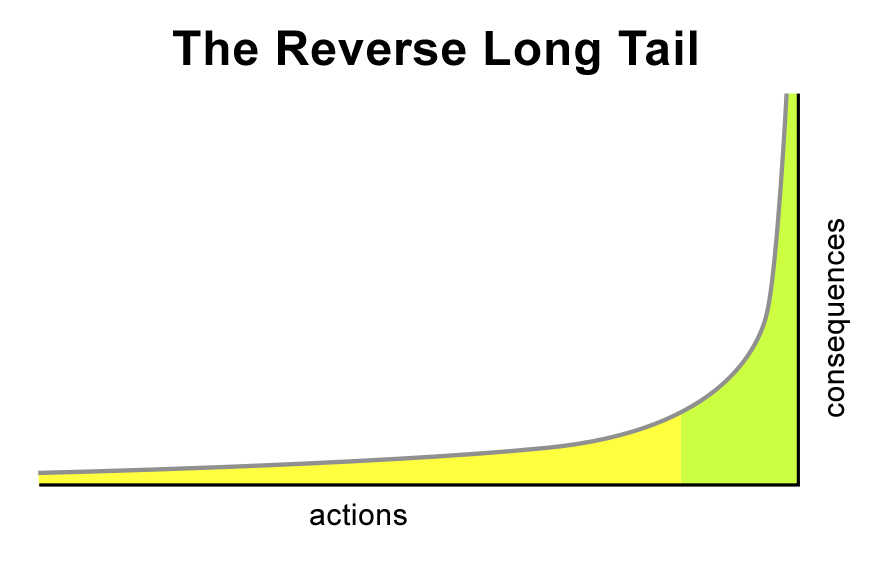
Each of your actions have what seem to be small consequences, however over the long run things begin to snowball and consequences increase.
Hence why…. perseverance is genius.
(Orig Picture by Hay Kranen / PD. Modified by Ben Young.)